Transactional Analysis (TA) is is a psychoanalytic theory and method of therapy, developed by Eric Berne during the 1950s. In TA, transactions refer to the exchange of communication between people. So, during a conversation with someone, the one starting the communication will give the ‘transaction stimulus’ and then the person receiving this stimulus will give the ‘transaction response’.
Transactional analysis is the method used to analyses this process of transactions within communication. It requires us to be aware of how we feel, think and behave during interactions with others.
TA theory recognises that the human personality is made up of three “ego states”. Each ego state is an entire system of thoughts, feelings, and behaviours from which we interact with one another. The Parent, Adult and Child ego states and the interaction between them are an integral part of transactional analysis theory.
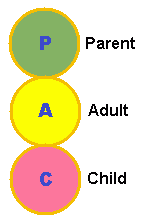
Parent Ego State
Think for a moment about the significant people in your early life. Your parents, aunts, uncles, older siblings and teachers, anyone who meant something to you. Anyone who has positively and negatively influenced you. Your Parent Ego State contains all these individuals. At any given moment you could go into thinking, feeling and behaving like one of them. There may be times when you are triggered and respond like them. Let’s imagine that your father was a very angry man and shouted a lot at you and your family members. When you get angry you might find yourself shouting and saying some of the things your father said when he was angry. Lets look at some examples…
Example 1, Critical Parent

Chris saw himself as a leader in his group of friends and he always set the time that they should meet, where they were going and what they did. He often shook his finger at his friends disapprovingly and commented on what they were doing wrong.
Example 2, Nurturing Parent

Emma and Clare were good friends and they went everywhere together. When Clare’s mother died it was Emma who looked after her and often put her arm around Clare saying ‘Don’t worry, I will help you’.
Adult Ego State
In our Adult Ego State we are in the here and now, rational and aware. Our feelings will be appropriate to the situation, for example when in danger the appropriate feeling is scared, which then motivates us to take action to avoid that threat. We are aware of ourselves, how we impact on others, and are able to take account of what is going on around us.
Using the example of the critical friend, if in our Adult Ego State, we would think through why is this person might be behaving like this at this time, maybe they are having a difficult time or there is something that we have done to upset this person. We would then come up with a strategy to deal with the situation.
Child Ego State
Our Child Ego state contains all our memories and ways of being from the past. It is when we are triggered back into earlier times and experiences, and we feel as we did then. It might be that your manager at work has scolded you for being late and you feel tearful, young and are triggered back to being ‘told off’ at home or at school. We can be triggered back to many early experiences but there will be some that are more ingrained than others, particularly any significant negative events in our life. In the example of the rude colleague – in your Child Ego State you may be triggered back to a time when you felt alone and isolated and felt very sad.
Example 1, adapted child

Lucy didn’t want to look after her friends children, but when asked she nodded and smiled and said “yes of course” because she wanted to please her friend.
Example 2, Free child

Katie had gone out for the day in the countryside and joyfully skipped over the rocks. She felt the sun on her face and was in awe of the view.
An example of the difference between the free and adapted child ego state would be for example, the person who complies to almost anything and perhaps may automatically say ‘thank you’ whilst repressing other feelings as opposed to the free child stance of free and spontaneous feelings, according to the situation.
How do we recognise Ego States?
Berne (1961, p. 76) listed four ways of recognising ego states and how they manifest into observable behaviours. He called them behavioural, social, historical and phenomenological diagnosis.
He suggests you could achieve a more exact diagnosis using more than one therapeutic analysis at a time, with behavioural diagnosis being the most important with the other three assisting.
Observing behaviour is a way to find what ego state a person is in by listening to their words, the tone in which they are used, body language, skin tone, hand gestures, facial expressions, body posture, eye movements and so on.
Observing behaviour is a way to find what ego state a person is in by listening to their words, the tone in which they are used, body language, skin tone, hand gestures, facial expressions, body posture, eye movements and so on.
A historical diagnosis relates to interactions and experiences as a child with parents and parental figures.
If decorating at my home is discussed, this can place us in our Negative Adapted Child, as I would make a groaning noise and say something like, “Oh I hate decorating, it’s boring and I can’t be bothered”.
A good question for this may be “How did your parents act when they were decorating your home as a child?”
A phenomenological diagnosis may be described as re-experiencing the past, rather just remembering it.
Berne (1961) states that “a phenomenological diagnosis is validated if the individual can fully re-experience in full intensity, with little weathering”.
One way in which this theory could be used is by sitting in a chair, asking a parent (virtually in front of you) why he reacted the way he did with a particular experience you recall and to see how that plays out.
References
- Stewart, I. and Joines, V. (2012) TA Today: A New Introduction to Transactional Analysis. 2nd edn. Melton Mowbray, Lifespace Publishing.
- Berne, E. (1961) Transactional Analysis in Psychotherapy. New York, Grove Press.
 Barefoot Psychotherapist